





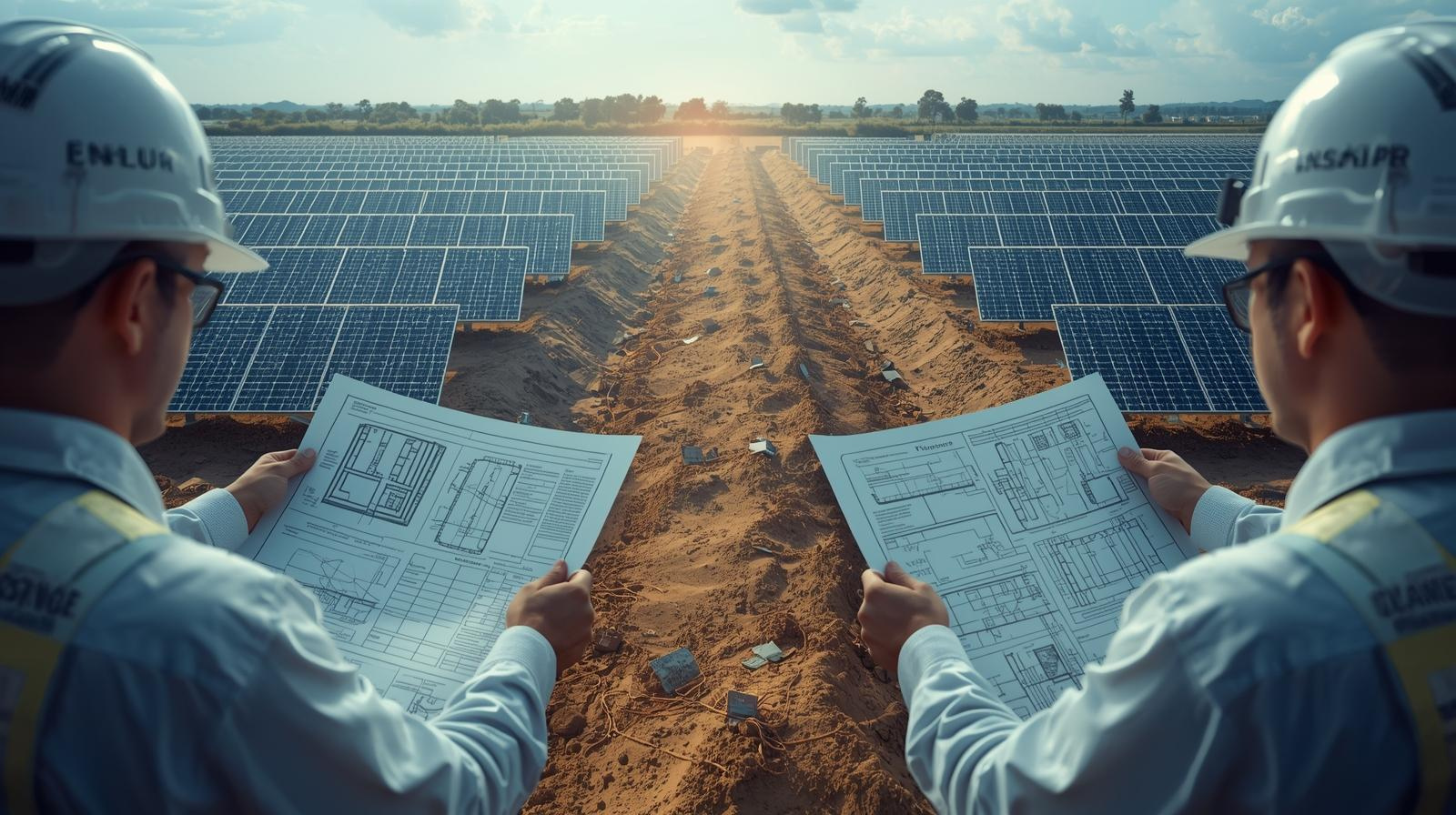
Solar Design vs Execution Gap is one of the biggest hidden risks in 1MW–50MW solar projects. In fact, most failures do not occur during commissioning — they begin much earlier during engineering planning.
When this Solar Design vs Execution Gap is ignored, layout mismatches, structural oversights, cable routing errors, and yield miscalculations quickly emerge. As a result, projects often experience:
-
Cost overruns
-
Construction delays
-
Design revisions
-
Reduced plant performance
Ultimately, for EPC companies, these engineering gaps directly impact profitability and long-term project credibility.
Understanding the Solar Design vs Execution Gap in MW Projects
Many solar designs are created primarily to secure approvals. However, very few are engineered for smooth and efficient construction.
There is, therefore, a critical difference between a permit-ready drawing and an execution-focused engineering package.
When engineering stops at compliance instead of constructability, problems begin. In real-world execution, these problems surface at the most expensive stage — during construction.
1️⃣ Structural Load & Foundation Mismatch
In MW-scale ground-mounted projects, structural accuracy is non-negotiable. From an engineering standpoint, even small calculation errors can escalate into major field challenges.
Common issues include:
-
Underestimated wind loads
-
Incorrect soil assumptions
-
Improper pile depth calculations
-
Tracker misalignment tolerances
When these miscalculations are discovered on-site, EPC teams are forced to redesign foundations, recalculate loads, and delay installation schedules. Consequently, financial pressure increases and client confidence weakens.
2️⃣ DC String Configuration Changes During Installation
One of the most frequent execution issues in solar plants is last-minute DC string modification. In many cases, this occurs because early-stage electrical simulations were not fully aligned with site realities.
Typical causes include:
-
Improper inverter loading analysis
-
Field constraints not considered during layout
-
Voltage drop miscalculations
-
Cable routing complexity underestimated
As a result, when strings are reconfigured on-site, labor costs increase, cable wastage occurs, and performance predictions become unreliable.
Therefore, proper engineering simulation before construction is not optional — it is critical.
3️⃣ Cable Routing & Voltage Drop Underestimation
In 10MW+ projects, cable design directly impacts energy efficiency and installation complexity. Technically speaking, even minor routing inefficiencies can reduce long-term performance.
Common execution gaps include:
-
Unrealistic trench routing
-
Ignoring terrain variations
-
AC cable oversizing or undersizing
-
Combiner box misplacement
A poorly engineered cable layout may reduce yield by 1–3% annually. Over time, this significantly impacts project IRR and investor returns.
4️⃣ Shadow Analysis vs Real-World Spacing
Many layout designs rely on simplified spacing assumptions. However, real-world conditions are rarely uniform.
Actual challenges include:
-
Terrain undulations
-
Obstructions
-
Seasonal sun angle variations
-
Tracker backtracking limitations
If these variables are not deeply simulated during design, EPCs are forced into module rearrangement and structural adjustments during construction. Consequently, generation output suffers and timelines extend.
Execution-stage shadow discovery is both expensive and avoidable.
5️⃣ Yield Simulation Without Execution Context
Simulation tools like PVsyst are powerful — but only when applied with field awareness. While yield software can generate attractive projections, ignoring practical loss factors creates unrealistic expectations.
Critical factors often overlooked include:
-
Actual cable loss
-
Temperature derating
-
Inverter clipping
-
Real module degradation
When projected output differs significantly from actual performance, financial disputes may arise.
Ultimately, engineering precision protects long-term bankability.
The Financial Impact of Engineering Gaps
Let’s quantify the risk in a 20MW project.
-
2% yield loss = major annual revenue reduction
-
15-day construction delay = manpower & machinery cost escalation
-
Structural redesign = additional civil expenses
-
Cable rework = material waste
These are not minor adjustments. On the contrary, they directly reduce EPC margins and erode profitability.
Why EPC Companies Must Shift to Execution-Focused Design
Execution-focused solar engineering includes:
For example, our detailed ground-mounted engineering services focus on constructability, structural accuracy, and simulation-backed layouts.
-
Detailed structural load calculations
-
Accurate soil-based foundation design
-
Optimized DC/AC ratio simulation
-
Terrain-based layout modeling
-
Realistic cable routing plans
-
Interdisciplinary coordination
In short, design must anticipate field conditions — not react to them.
The Strategic Advantage of Pre-Construction Engineering
When engineering gaps are eliminated before procurement and construction:
✔ Revisions reduce dramatically
✔ Approval processes accelerate
✔ On-site coordination improves
✔ Project timelines stabilize
✔ Investor confidence increases
Therefore, experienced engineering support becomes a strategic advantage rather than an added cost.
Final Thought
Most MW-scale solar projects do not fail because of technology. Instead, they fail because the transition from design to execution is weak.
In today’s competitive EPC environment, profitability depends on precision engineering — not reactive problem-solving. Ultimately, the future of successful 1MW–50MW projects lies in bridging the Solar Design vs Execution Gap before construction begins.
