





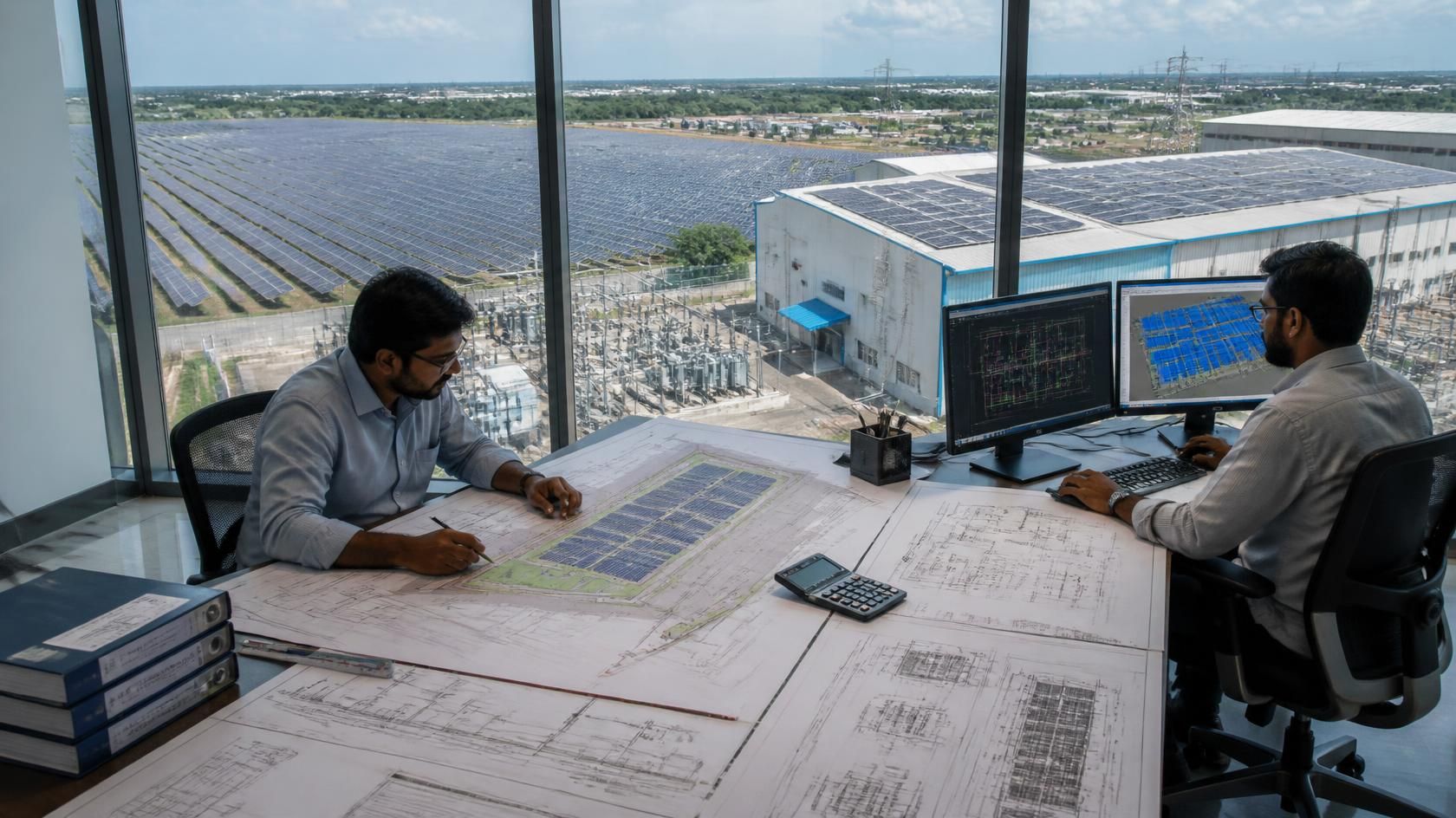
India’s solar capacity in India has reached another major milestone, reflecting the rapid expansion of the country’s renewable energy market. But this growth means more than new business opportunities for solar EPCs. As solar capacity increases, project volumes, engineering requirements, procurement coordination and execution pressure are also rising. For EPC companies, the real challenge is no longer simply winning more projects—it is building the engineering and execution capacity needed to deliver them consistently.
It is scaling at a pace that is changing how the entire EPC industry needs to work.
By the end of July 2026, India’s installed solar capacity had reached 164.59 GW, according to the latest reported national capacity figures. Solar now represents a major part of India’s rapidly expanding non-fossil generation base.
But the bigger story is not simply the number.
164 GW means more projects, more EPC opportunities and, at the same time, more pressure on project execution.
As the market becomes larger, EPC companies cannot depend only on faster installation.
Better preparation becomes essential as project volumes increase. Strong engineering provides the technical foundation for execution, while closer coordination with procurement helps keep equipment, quantities and designs aligned.
And they need processes that can handle multiple projects without allowing small design issues to become expensive site problems.
Because when an industry scales, the question changes.
It is no longer:
“Can we execute this project?”
The more important question becomes:
“Can we execute the next ten projects with the same level of control?”
India’s Solar Market Has Entered a Different Phase
India’s solar journey has changed dramatically over the past decade.
MNRE data shows how significant this transformation has been. Solar capacity stood at around 2.82 GW in 2014 and reached 162.15 GW by June 2026, according to the Ministry’s published data.
By June 2026, the installed solar base included approximately:
- 121.25 GW of ground-mounted solar
- 30.11 GW of rooftop solar
- 4.36 GW of hybrid solar
- 6.43 GW of off-grid solar
MNRE reported cumulative solar capacity of 162.15 GW as of June 30, 2026.
The July milestone pushes the industry beyond another major threshold.
And this growth is creating a very different operating environment for EPC companies.
Earlier, an EPC could focus heavily on winning individual projects.
Today, many companies are thinking about:
How do we win more projects without losing control over execution?
That is a much harder business problem.
More Solar Capacity Means More EPC Pressure
When solar capacity grows, the opportunity for EPCs obviously grows with it.
But project volume does not automatically mean higher profitability.
A company can win more orders and still struggle if its internal process cannot handle the additional workload.
Think about what happens when an EPC moves from five projects to fifteen projects.
The company suddenly has:
- More site surveys
- More client approvals
- More engineering drawings
- More procurement requirements
- More vendors
- More BOQs
- More structural calculations
- More electrical drawings
- More site teams
- More revisions
- More coordination
The problem is not necessarily the number of projects.
The problem is managing all those projects consistently.
That is where engineering becomes much more important.
The Next Challenge Is Not Installation Speed
Solar EPCs naturally focus on installation speed.
And for good reason.
Faster installation can improve project schedules and resource utilization.
But speed at the site cannot compensate for poor preparation before the site team begins work.
A project can have an excellent installation team and still face delays because:
- The layout was revised late.
- The structure did not match the site.
- The inverter location changed.
- Cable routes were unclear.
- The BOQ did not match the final design.
- The electrical drawings were incomplete.
- Client comments arrived after procurement.
- Site conditions were different from the assumptions.
The installation team then spends time solving engineering problems that should ideally have been addressed earlier.
This is one of the biggest challenges created by a rapidly expanding solar market.
More projects require more engineering discipline, not simply more manpower.
Growth Exposes Weak Processes
A small EPC can sometimes survive on informal coordination.
The project manager knows the engineer.
The engineer knows the procurement person.
The site supervisor can call the project head directly.
Everyone knows what is happening.
But as the company grows, this becomes difficult.
Imagine running ten or twenty projects simultaneously.
One project has a rooftop layout revision.
Another needs a structural change.
A third project has a different inverter.
A fourth requires a revised SLD.
Another is waiting for client approval.
Another is already under procurement.
Without a structured engineering process, information starts moving through calls, WhatsApp messages, spreadsheets and multiple versions of drawings.
That is where mistakes start appearing.
A growing EPC therefore needs something more valuable than speed.
It needs repeatability.
The Difference Between a Busy EPC and a Scalable EPC
Being busy does not necessarily mean an EPC is scalable.
A busy EPC may have:
More projects → More people → More coordination → More firefighting
A scalable EPC aims for:
More projects → Better systems → Better engineering control → Predictable execution
That difference is critical.
A company cannot indefinitely solve every new project by simply adding people.
At some point, the process itself has to become stronger.
And engineering is one of the first areas where that process needs to mature.
Why Engineering Becomes a Growth Factor
Engineering is sometimes treated as a supporting activity.
The project is won.
The site is surveyed.
Then the engineering team prepares drawings.
But in a growing solar business, engineering can influence almost every stage of the project.
Consider a typical commercial rooftop project.
The engineering team determines:
- How many modules can realistically fit
- Where the modules should be placed
- How shading affects the layout
- Where the inverter should be located
- How cables should be routed
- How the structure should be arranged
- What electrical configuration is required
- What quantities are required
- How the installation team should execute the design
A strong design therefore does not simply produce a drawing.
It creates an execution framework.
That becomes increasingly important when an EPC has several projects running at the same time.
More Projects Also Mean More Procurement Complexity
The solar industry is becoming increasingly equipment-driven.
Different projects may involve different:
- Module specifications
- Inverters
- Structures
- Mounting systems
- Cable requirements
- Transformers
- Electrical equipment
If every project is designed differently without a controlled process, procurement becomes difficult.
The procurement team may receive changing quantities.
A module specification may change.
The inverter configuration may change.
A structure quantity may be revised.
The BOQ may have to be updated.
And every change creates another coordination requirement.
This is why procurement cannot operate separately from engineering.
A good procurement decision needs a clear engineering basis.
BOQ Accuracy Becomes More Important as Projects Scale
Imagine an EPC executing one small project.
A minor quantity error may be manageable.
Now imagine the same problem occurring across ten projects.
Small errors begin multiplying.
An inaccurate BOQ can create:
- Excess material
- Material shortages
- Emergency procurement
- Additional logistics
- Site delays
- Wastage
- Margin pressure
The issue is not always that the engineer made a major mistake.
Sometimes the problem is simply that the design changed after the BOQ was prepared.
This is why a disciplined workflow should connect:
Design → BOQ → Procurement → Execution
rather than treating them as separate activities.
Ground-Mount Projects Make This Even More Important
India’s solar growth is heavily driven by large ground-mounted projects.
MNRE’s June 2026 data showed approximately 121.25 GW of ground-mounted solar capacity, significantly larger than the rooftop segment.
Ground-mounted projects bring their own engineering challenges.
The project may involve:
- Land optimization
- Row spacing
- Module orientation
- Topography
- Structural design
- Pile positions
- DC cable routing
- Inverter locations
- Internal roads
- Drainage
- Equipment access
- Electrical collection systems
A design decision in one area can influence another.
For example, changing row spacing can affect land utilization.
A change in table configuration can alter structure quantities. Inverter placement also influences cable lengths, while the selected module can affect the entire DC design. Even a seemingly small equipment change can therefore create several downstream engineering adjustments.
This is why MW-scale projects require engineering to happen before execution pressure becomes critical.
Rooftop Projects Have a Different Challenge
Rooftop solar is another major part of India’s growing solar market.
MNRE reported approximately 30.11 GW of rooftop solar capacity as of June 30, 2026.
But rooftop projects are not simply smaller versions of ground-mounted projects.
They are often more constrained.
The engineer may have to work around:
- Existing equipment
- Water tanks
- HVAC systems
- Parapet walls
- Multiple roof levels
- Access pathways
- Shadow-producing structures
- Structural limitations
- Existing electrical infrastructure
That makes detailed design especially important.
A layout that looks good on a computer screen may not necessarily be easy to install.
The real objective is not maximum module count.
It is maximum practical project value.
The Hidden Problem: Engineering Workload Grows With Project Volume
There is another side to market growth that is rarely discussed.
When the number of projects increases, engineering workload increases too.
But engineering teams do not always grow at the same speed.
This creates pressure.
One engineer may suddenly have to handle:
- Proposal designs
- Client revisions
- Detailed layouts
- Electrical drawings
- Structural drawings
- BOQs
- Site queries
- Revision requests
- As-built updates
The result can be predictable.
Important work gets pushed toward the deadline.
Drawings are prepared faster.
Review time decreases.
Revisions increase.
And site teams start asking questions that should have been answered before mobilization.
That is not a technology problem.
It is a capacity and process problem.
Successful EPCs Are Building Engineering Capacity Differently
The strongest EPCs do not necessarily try to perform every engineering task internally.
Instead, many growing businesses build a combination of:
Internal project management + internal execution + specialized engineering support
This allows the EPC to keep control over the project while using specialist support where additional capacity or expertise is required.
For example, an EPC may keep client communication and site execution internally while using dedicated engineering support for:
- 3D pre-design
- Detailed rooftop design
- Ground-mount layouts
- Electrical SLDs
- Structural design
- Fabrication drawings
- STAAD-based analysis
- BOQ support
- Execution-ready drawings
This approach can help an EPC increase its project capacity without creating unnecessary internal bottlenecks.
Engineering Support Is Not About Outsourcing Responsibility
This distinction matters.
Professional engineering support should not mean:
“Send the project outside and forget about it.”
The better model is collaboration.
The EPC provides:
- Project requirements
- Site information
- Client specifications
- Equipment preferences
- Execution constraints
The engineering partner converts those inputs into:
Clear, coordinated and execution-ready technical information.
The EPC remains responsible for project delivery.
But the engineering process becomes more structured.
That is particularly valuable when project volume increases faster than internal engineering capacity.
What a Scalable Solar EPC Should Standardize
There is no single process that works for every EPC.
But several areas can benefit from standardization.
1. Pre-Design
Create a clear engineering basis before commercial commitments become difficult to change.
2. Equipment Inputs
Use confirmed module and inverter specifications wherever possible.
3. Design Templates
Standardize repetitive drawing structures without compromising project-specific engineering.
4. Revision Control
Make sure everyone is working from the latest drawing version.
5. BOQ Coordination
Keep quantities connected to the approved design.
6. Electrical Coordination
Ensure SLDs, string layouts, cable routes and equipment selections remain aligned.
7. Structural Coordination
Make sure the structural design reflects the actual module, mounting system and site conditions.
8. Site Feedback
Use execution feedback to improve future designs.
These practices may look simple.
But when repeated across dozens of projects, they can create a major difference.
The Real Competitive Advantage Is Predictability
Solar EPC competition is not only about price.
Clients increasingly care about whether the EPC can deliver what it promised.
They want:
- Clear timelines
- Accurate quantities
- Professional documentation
- Fewer surprises
- Better communication
- Reliable execution
This creates an important business advantage.
Predictability.
An EPC that consistently delivers predictable projects can become more valuable than one that simply offers the lowest initial price.
And predictable execution begins long before the installation team arrives at the site.
Where Eden Solar Design Fits Into This Growth
As India’s solar market expands, EPCs will increasingly need engineering capacity that can scale with project demand.
This is where Eden Solar Design works as a professional solar design and engineering support partner for EPCs, installers and project developers.
The focus is not on taking over the EPC’s role.
It is on strengthening the engineering layer behind project execution.
Depending on project requirements, this can include:
- Solar 3D pre-design and post-design
- Rooftop detailed engineering
- Ground-mount solar design
- MW-scale design consultancy
- Electrical SLDs
- CEIG electrical approval drawings
- Civil and structural engineering
- Structural design with BOM
- Fabrication drawings
- STAAD-based structural analysis
- Pre-design for client proposals
- Detailed execution-ready drawings
For a growing EPC, this type of support can help connect the stages between project opportunity and project execution.
The goal is simple:
More clarity before the site team starts work.
The Bigger Question for EPC Owners
India crossing another major solar capacity milestone is good news.
The expanding market brings new opportunities for solar companies. For EPCs, this creates more room to win projects and build stronger businesses. The real challenge is turning that market growth into sustainable, well-controlled growth.
But growth also creates pressure.
The EPCs that benefit most may not simply be the ones that win the most orders.
They may be the ones that can handle increasing project volume without allowing engineering quality, procurement control and execution discipline to fall behind.
That requires a change in mindset.
Instead of asking:
“How quickly can we install this project?”
ask:
“How well have we prepared this project for installation?”
That question can change the entire execution process.
Conclusion: India’s Solar Growth Is Also an Engineering Challenge
India’s solar capacity has moved from a niche renewable-energy segment to one of the country’s most important power-generation growth areas.
The latest capacity numbers are impressive.
But behind every additional megawatt is a project that has to be:
Surveyed. Designed. Procured. Approved. Installed. Tested. Commissioned.
As the number of projects increases, the cost of poor coordination increases with it.
A growing project pipeline brings more drawings, equipment decisions and BOQs. Site teams also multiply, creating greater coordination pressure across projects. With more revisions moving between engineering and execution, the chances of something going wrong increase as well.
That is why the next phase of India’s solar growth will not be driven by installation capacity alone.
It will also be driven by engineering capacity, process discipline and execution readiness.
For EPCs, the opportunity is clear.
Build the engineering process before the project volume becomes difficult to control.
Because the ability to execute one successful solar project is valuable.
But the ability to execute many projects consistently is what creates a scalable solar EPC business.
India’s solar market is getting bigger.
The EPC opportunity is getting bigger with it.
Now the engineering process needs to grow just as fast.
Eden Solar Design helps solar EPCs, installers and project developers build that engineering strength with professional, execution-focused solar design support.
