





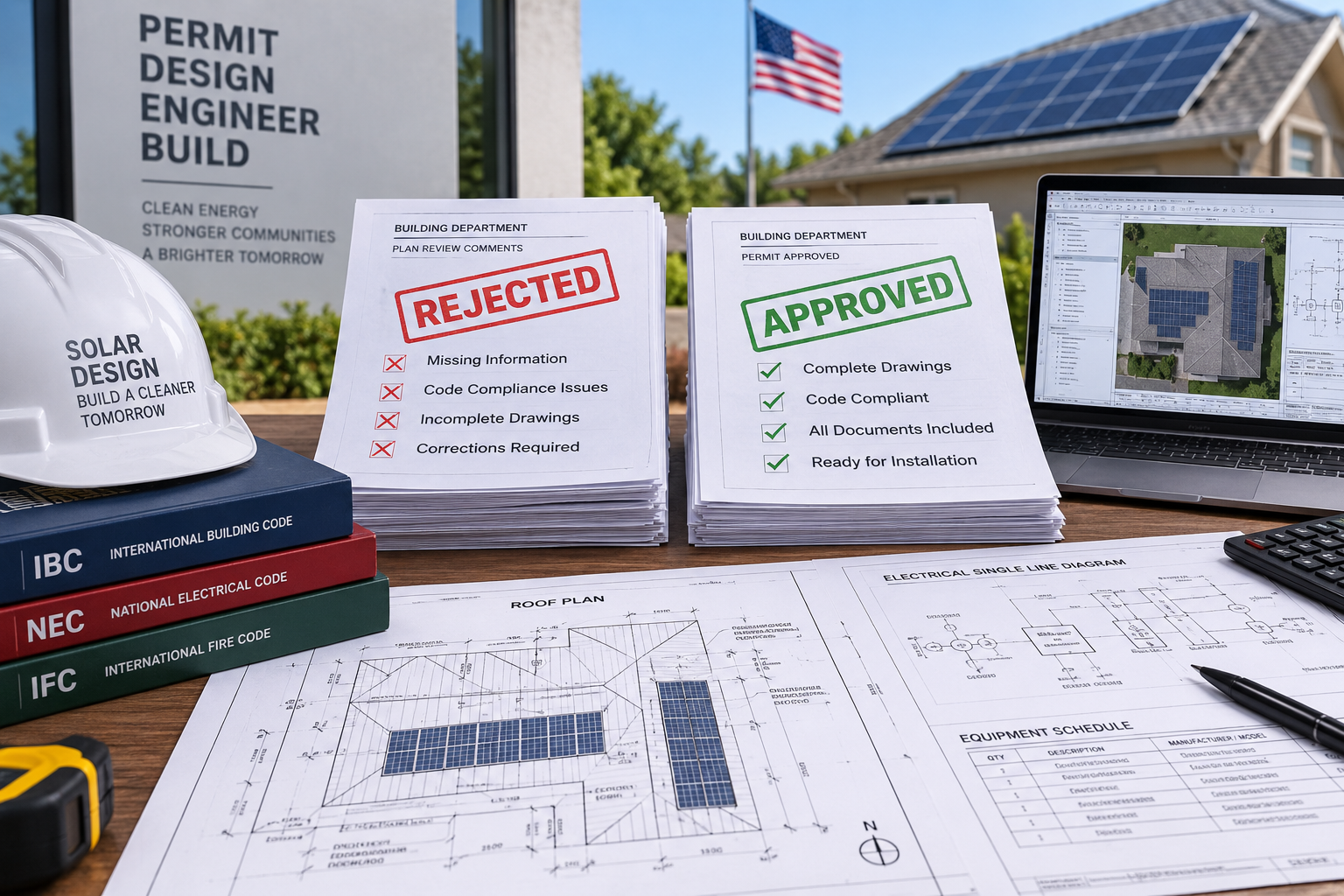
A solar project can have the right equipment, a good customer, and a strong business case — yet still get delayed before installation even begins.
One common reason is simple: the permit drawings are not ready for approval.
In the US solar market, permit drawings are more than technical documents. They are what allow an Authority Having Jurisdiction (AHJ) to understand how a proposed solar installation will be built, how it connects to the existing electrical system, and whether the project meets applicable code and local requirements.
When drawings are incomplete, inconsistent, or missing critical information, the result can be plan-review comments, correction notices, resubmissions, and lost project time.
For solar EPCs and installers managing multiple projects, even a small drawing issue can become a major operational problem.
The good news is that many permit rejections are preventable.
The key is understanding what reviewers look for, where drawings commonly fail, and how a permit-ready engineering process can reduce unnecessary revisions.
What Does “Permit-Ready” Actually Mean?
A permit-ready solar drawing package is not simply a drawing that looks professional.
It needs to communicate the proposed project clearly enough for the relevant reviewer to evaluate it.
Depending on the project, jurisdiction, and system type, a package may include:
- Site or roof plan
- PV module layout
- Equipment locations
- Structural information
- Electrical single-line diagram
- Three-line diagram where required
- Conductor and conduit information
- Equipment specifications
- Existing and proposed electrical service information
- Rapid shutdown information
- Grounding and bonding details
- Disconnect locations
- Load calculations
- Structural calculations
- Mounting details
- Roof attachment information
- Fire access pathways
- Required notes and code references
- Professional engineer documentation or stamp where required
The exact requirements vary by jurisdiction.
That is one of the biggest challenges for US solar companies.
A drawing package that works for one AHJ may not automatically work for another.
Why Do Solar Permit Drawings Get Rejected?
Most permit problems do not come from one dramatic engineering failure.
They often come from small details that do not match.
A module count may be different between the layout and electrical diagram.
An inverter shown on the site plan may not match the equipment schedule.
A disconnect may appear in one location but be described differently elsewhere.
A structural attachment detail may be missing.
A required calculation may not be included.
Each individual issue may look minor.
Together, they can stop the permit process.
Here are some of the most common reasons.
1. The Drawings Are Incomplete
One of the most obvious reasons for permit corrections is an incomplete drawing package.
A project may have a basic PV layout and an SLD, but the reviewer may need additional information to verify the installation.
For example, the package may not clearly show:
- Module orientation
- Inverter location
- Electrical equipment
- Disconnects
- Conduit routing
- Equipment ratings
- Structural attachment method
- Roof pathways
- Required setbacks
- Existing service information
When information is missing, the reviewer has to ask for it.
That creates another review cycle.
And another review cycle means more time before installation.
2. Different Drawings Do Not Match
This is one of the most avoidable problems in solar permitting.
Imagine a project with:
24 PV modules on the layout
but the electrical SLD shows:
22 modules.
The inverter model on one drawing is also different from the equipment schedule.
The service rating shown on the electrical sheet does not match the information used in the calculations.
Now the reviewer has to determine which information is correct.
This creates uncertainty.
A strong permit package should tell one consistent story across every sheet.
The layout, SLD, structural documents, calculations, equipment schedule, and notes should all represent the same project.
3. Electrical Design Information Is Not Clear
Solar permitting depends heavily on electrical documentation.
The reviewer needs to understand how the PV system connects to the existing electrical infrastructure.
That means important information must be presented clearly.
Depending on the system, this can include:
- PV system size
- Module configuration
- Inverter information
- String configuration
- Conductor sizes
- Conduit sizes
- Overcurrent protection
- Disconnects
- Grounding and bonding
- Service equipment
- Interconnection method
- Point of connection
- Rapid shutdown
- Equipment ratings
If the electrical design is unclear, incomplete, or inconsistent, correction comments are likely.
A clean electrical SLD can make the review process significantly easier because it gives the reviewer a concise view of the system.
4. Structural Information Is Missing or Too Generic
Electrical design is only one side of a solar permit.
The physical installation also needs to be addressed.
For rooftop projects, reviewers may need information related to:
- Roof structure
- Attachment method
- Rail or mounting system
- Attachment spacing
- Roof type
- Existing framing
- Structural loading
- Wind loads
- Snow loads where applicable
- Attachment details
- Equipment weights
A generic statement such as “roof is structurally adequate” may not provide enough information for a specific project.
Structural engineering needs to correspond to the actual site, mounting system, and applicable requirements.
This becomes particularly important when a project requires a PE-stamped structural design or calculations.
5. PE Stamp Requirements Are Not Properly Addressed
Not every solar project requires exactly the same level of professional engineering involvement.
Requirements can vary based on:
- State
- AHJ
- Project type
- Structural conditions
- System size
- Building type
- Local permitting requirements
For projects where a professional engineer’s seal is required, submitting drawings without the appropriate engineering review can create delays.
A PE stamp is not simply a graphic added to the last page.
The underlying engineering should support what is being certified.
That means the design package should be properly coordinated before it reaches the professional engineer for review and sealing.
Good engineering makes the stamping process easier.
6. The Design Does Not Follow Local AHJ Requirements
The US does not operate with one universal solar permitting workflow.
Different jurisdictions can have different submission requirements.
An AHJ may require specific:
- Drawing formats
- Notes
- Calculations
- Structural documentation
- Electrical information
- Equipment schedules
- Site plans
- Fire access details
- Signage
- Application documents
Even when a design generally follows national code requirements, local requirements can still affect the permit package.
That is why copying the same drawing set from one project to another can create problems.
Standardization is useful. Blind standardization is not.
A good engineering workflow should use standardized templates while still adapting the package to the specific jurisdiction and project.
7. Roof Layout and Fire Access Are Not Properly Coordinated
Rooftop solar design is not only about fitting the maximum number of modules onto the roof.
The layout also needs to consider required access and clearances.
Depending on the jurisdiction and building conditions, reviewers may evaluate:
- Roof access
- Pathways
- Module setbacks
- Ridge clearances
- Equipment access
- Fire department access
- Obstructions
- Roof edges
- Mechanical equipment
A design that maximizes module count but ignores required access can create permitting problems.
This is where good engineering becomes more valuable than simply filling available roof space.
The best layout is not always the one with the most modules.
It is the one that balances energy production, safety, structural requirements, electrical requirements, and permitting constraints.
8. Equipment Information Is Inconsistent
Equipment schedules are another common source of corrections.
The reviewer may need to verify:
- Module model
- Inverter model
- Optimizer or MLPE information
- Battery model
- Disconnect ratings
- Combiner information
- Panel ratings
- Equipment locations
- Manufacturer information
If the equipment shown on the drawing does not match the actual equipment being proposed, the permit package can become difficult to verify.
This is especially important when equipment changes during project development.
A module or inverter substitution should not simply be changed in one place.
The entire drawing package needs to be reviewed for coordination.
9. Calculations Are Missing or Incorrect
Some permit packages fail not because the drawings look wrong, but because the supporting calculations are incomplete.
Depending on the project, calculations may address areas such as:
- Conductor sizing
- Voltage drop
- Overcurrent protection
- Equipment ratings
- Load calculations
- Rapid shutdown
- Voltage calculations
- Structural loading
- Wind loading
- Snow loading
- Electrical service capacity
Calculations should correspond to the actual design.
Changing equipment after calculations are completed can affect the engineering.
That is why design revisions need to be controlled rather than handled casually.
The Hidden Cost of a Permit Rejection
A correction notice may look like a technical issue.
For an EPC, however, it can affect the entire project workflow.
A permit delay can create:
Engineering revision → Resubmission → Additional review → Installation delay → Schedule pressure
That pressure can eventually affect procurement, labor planning, customer communication, and project cash flow.
The problem becomes even bigger when an EPC is handling dozens or hundreds of projects.
A small percentage of rejected or repeatedly revised permit packages can consume significant engineering and project-management time.
This is why permit quality should be treated as an operational metric, not just a drafting issue.
How to Get Solar Permit Drawings Right the First Time
Getting every permit approved on the first submission cannot always be guaranteed.
AHJ requirements vary, and reviewers may request additional information.
But EPCs can significantly reduce avoidable corrections by improving the engineering process.
Here is where the difference starts.
Start With Complete Project Information
Before engineering begins, collect the information required for the specific project.
This can include:
- Site address
- Roof information
- Existing electrical service
- Utility information
- Project capacity
- Module selection
- Inverter selection
- Battery information
- Structural information
- Roof type
- Site photos
- Equipment locations
- Interconnection information
- Applicable AHJ requirements
The better the input data, the better the engineering output.
Trying to create permit drawings from incomplete information often creates revisions later.
Build the Design Around the Actual Site
Permit drawings should represent the real project.
For rooftop systems, that means understanding:
- Roof geometry
- Obstructions
- Roof edges
- Access pathways
- Equipment
- Structural conditions
- Electrical service location
For ground-mounted systems, the engineering process can involve additional considerations such as:
- Site boundaries
- Terrain
- Module arrangement
- Structural foundations
- Equipment locations
- Cable routing
- Access roads
- Drainage
- Electrical infrastructure
A permit package becomes stronger when the drawings reflect actual site conditions rather than assumptions.
Coordinate Every Drawing Before Submission
One of the most valuable checks is a complete drawing coordination review.
Compare:
PV layout ↔ SLD ↔ Equipment Schedule ↔ Structural Drawings ↔ Calculations
Check:
- Module quantity
- System capacity
- Inverter model
- Equipment locations
- Conductor sizes
- Disconnects
- Service information
- Mounting system
- Structural details
- Notes
- Calculations
The goal is simple:
Every sheet should describe the same project.
Use a Permit-Ready Engineering Workflow
A strong workflow can look like this:
Step 1 — Project Information
Collect complete site and system information.
Step 2 — Site & System Review
Understand the roof, electrical service, equipment, and project constraints.
Step 3 — Solar Layout
Develop the PV layout with access, setbacks, equipment, and site conditions in mind.
Step 4 — Electrical Engineering
Develop the SLD and electrical details based on the actual system configuration.
Step 5 — Structural Engineering
Prepare structural details and calculations appropriate to the project.
Step 6 — Code & AHJ Review
Check the package against applicable code requirements and local submission requirements.
Step 7 — Drawing Coordination
Cross-check all sheets, schedules, notes, and calculations.
Step 8 — PE Review & Stamp
Where required, send the coordinated engineering package for professional engineer review and sealing.
Step 9 — Final QA/QC
Perform a final submission check before the package reaches the AHJ.
This process may take more discipline upfront.
But it can save much more time later.
Permit-Ready Does Not Mean “Pretty Drawings”
A professional-looking drawing is not necessarily a permit-ready drawing.
Good graphics help.
Clear organization helps.
But engineering accuracy matters more.
A permit reviewer needs to quickly understand:
What is being installed?
Where is it being installed?
How is it connected?
How is it supported?
Does the design satisfy applicable requirements?
Is the information consistent throughout the package?
When those questions are clearly answered, the permit review becomes much easier.
Why US Solar EPCs Need Better Engineering Coordination
As solar companies scale, engineering becomes increasingly difficult to manage.
One project may be manageable with a small team.
But when an EPC is handling dozens of projects across different cities and jurisdictions, manually checking every detail becomes difficult.
That is where a structured engineering system becomes important.
Standard templates can improve consistency.
QA/QC checklists can catch common errors.
Drawing coordination can reduce contradictions.
Site-specific engineering can address project conditions.
PE review can provide professional certification where required.
Together, these processes create a more reliable permit workflow.
The Goal Is Not Just Permit Approval
Permit approval is an important milestone.
But the real goal is bigger.
The drawings should remain useful after approval.
The same engineering package may become a reference for:
- Procurement
- Installation
- Electrical work
- Structural installation
- Inspection
- Client communication
- Project documentation
- Future maintenance
A drawing package that is accurate enough for permitting but unclear for installation is not truly successful.
Permit-ready should also mean execution-ready.
Final Thoughts
Solar permit drawings are often treated as paperwork.
They are not.
They are the technical connection between the proposed solar system, the AHJ, the installer, and the physical project.
When drawings are incomplete, inconsistent, or poorly coordinated, the consequences can extend far beyond a correction notice.
They can affect schedules, installation planning, engineering workload, and customer expectations.
The solution is not simply to create more drawings.
It is to create better-coordinated engineering before submission.
A strong solar permit package starts with accurate project information, continues through coordinated electrical and structural engineering, adapts to local AHJ requirements, and ends with a disciplined QA/QC process.
For US solar EPCs, that approach can mean fewer avoidable corrections, smoother permit submissions, and greater confidence when the project moves from engineering to the job site.
The permit reviewer sees the drawings first.
The installer follows them later.
Getting them right matters from the very beginning.
