





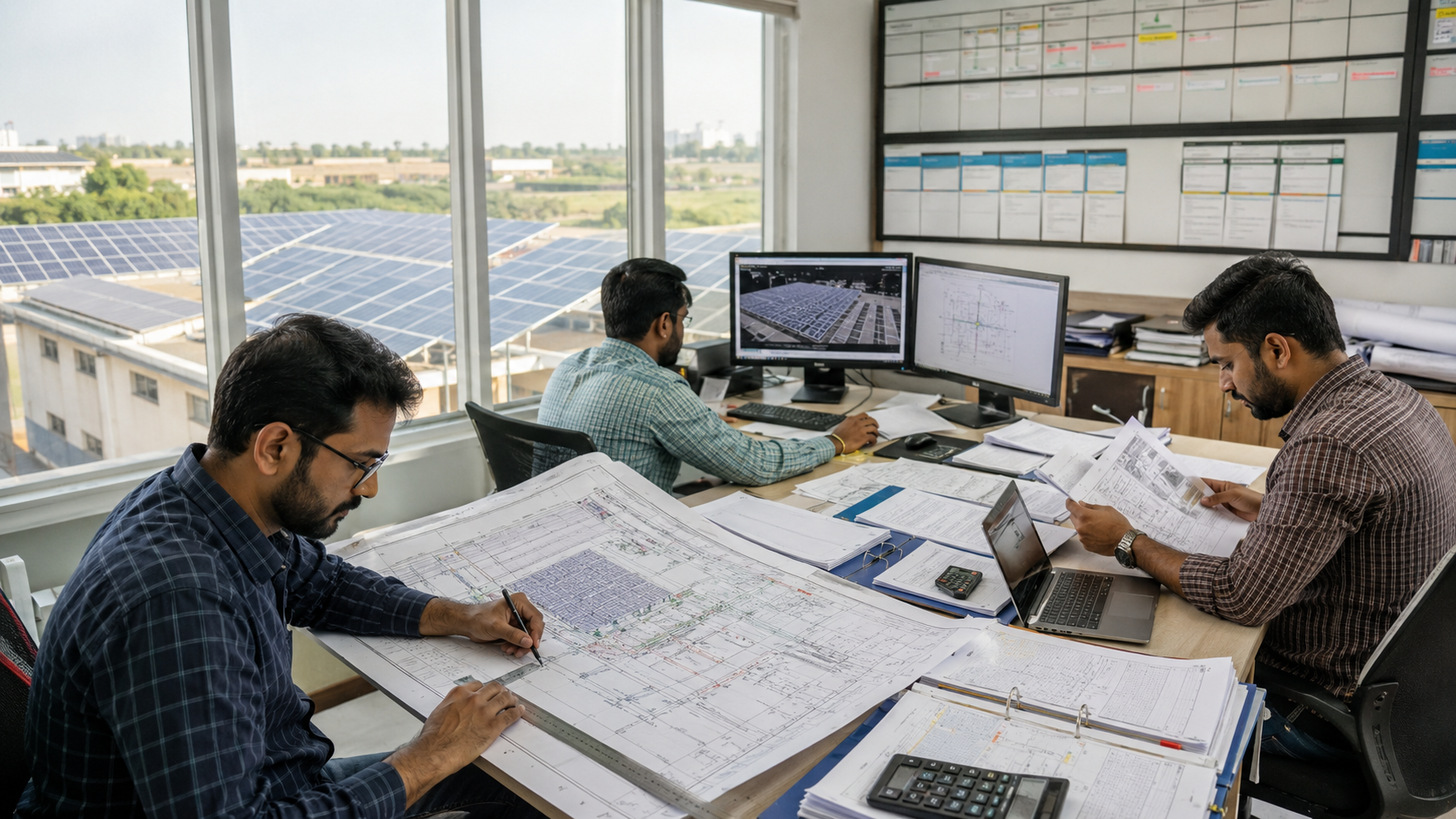
Solar EPC companies in India are winning more projects as the country’s solar market continues to expand. More capacity is being added, project sizes are increasing, and new opportunities are emerging across rooftop, commercial, industrial and utility-scale solar. But this growth brings another important question: can a solar EPC increase its project pipeline without putting excessive pressure on engineering, procurement and execution teams?
More capacity is being added.
lass=”yoast-text-mark” />>More large-scale projects are moving forward.
>>More rooftop installations are entering the market.
And more opportunities are opening up for solar EPC companies.
But there is another side to this growth that is not discussed enough.
Can EPC engineering capacity grow at the same speed as project demand?
That question is becoming increasingly important.
According to MNRE’s latest published physical-progress data, India had 162.15 GW of cumulative solar capacity as of June 30, 2026. Ground-mounted projects accounted for 121.25 GW, while grid-connected rooftop solar stood at 30.11 GW.
The pace of additions is also significant. Mercom India Research reported that India added 15.3 GW of solar capacity in Q1 2026, the highest quarterly addition recorded at that time, with large-scale projects accounting for 82% of the additions.
For EPCs, these numbers represent opportunity.
But they also represent pressure.
Because winning more projects is one challenge.
Delivering more projects consistently is another.
The Solar EPC Business Is Entering a Scale-Up Phase
For many years, the focus of solar EPC businesses was straightforward:
Find projects → quote → win → install → commission.
That model can work when project volumes are manageable.
But as the market grows, the number of activities behind every project also increases.
A growing EPC may suddenly be managing:
- Multiple site surveys
- Several client proposals
- Different module specifications
- Multiple inverter combinations
- Rooftop and ground-mount projects simultaneously
- Structural calculations
- Electrical drawings
- BOQs
- Procurement coordination
- Approval drawings
- Site revisions
- Client comments
- Execution queries
- As-built documentation
The project count may increase faster than the company’s internal engineering process.
And that is where the real bottleneck can appear.
Winning More Orders Does Not Automatically Mean Better Growth
There is a common assumption in the EPC business:
More orders = more growth.
But the relationship is not always that simple.
Suppose an EPC handled five projects comfortably last year.
This year, the company wins fifteen.
Revenue potential has increased.
The market opportunity looks stronger.
But what happens if the engineering team is still operating with the same process used for five projects?
The pressure starts appearing quickly.
Drawings take longer.
Client revisions accumulate.
BOQs are updated repeatedly.
Procurement waits for technical confirmation.
Site teams ask for missing information.
Engineers spend more time answering urgent questions.
Project managers spend more time coordinating between departments.
Eventually, the company may become busy without becoming truly scalable.
That is the difference between project growth and operational growth.
The Engineering Bottleneck Is Often Invisible at First
Engineering problems rarely announce themselves as a major business problem on day one.
They usually begin with something small.
A drawing is delayed by one day.
A client asks for a layout revision.
A module specification changes.
An inverter is replaced.
A structure needs modification.
A BOQ requires an update.
A site team finds that the drawing does not fully match actual conditions.
Individually, each issue may seem manageable.
But when several projects are running at the same time, these small issues start accumulating.
The engineering team moves from planned work to reactive work.
Engineering teams can end up spending valuable time fixing issues from previous projects rather than preparing upcoming designs. Documents that should be completed before execution may remain unfinished while engineers respond to urgent site queries. Without a controlled workflow, teams can also spend too much time tracking revisions and trying to identify the latest approved information.
That is where engineering capacity becomes a business issue.
More Projects Create More Engineering Complexity
A solar project may look simple from the outside.
Modules.
Inverters.
Structures.
Cables.
Electrical equipment.
But behind the installation is a chain of technical decisions.
For a typical project, engineering may need to coordinate:
Site information → Solar layout → Module selection → String design → Inverter configuration → Electrical design → Structural design → BOQ → Procurement → Execution
A change in one area can affect several others.
For example, changing the selected module can influence the layout, string configuration and structural arrangement.
A different inverter may require a revised DC/AC configuration.
A change in roof availability can affect module placement and cable routing.
A structural limitation may reduce the usable module area.
This means engineering is not a single drawing activity.
It is a coordination layer connecting different parts of the project.
Rooftop Projects Make Design Pressure More Visible
Rooftop solar is one of the important segments of India’s solar growth.
MNRE’s June 2026 data recorded 30.11 GW of grid-connected rooftop solar capacity.
But rooftop projects bring a different kind of engineering challenge.
There is rarely a completely empty surface waiting for modules.
Engineers may have to work around:
- Water tanks
- HVAC equipment
- Staircases
- Parapet walls
- Existing structures
- Multiple roof levels
- Shadow-producing objects
- Maintenance pathways
- Existing electrical equipment
- Access restrictions
The objective therefore cannot simply be:
“Fit as many modules as possible.”
A successful rooftop design needs to balance:
Capacity + shading + structure + access + electrical routing + installation practicality
This is why detailed rooftop engineering becomes increasingly important as project volumes increase.
A weak layout may still look acceptable during proposal stage.
The problems often become visible when the installation team reaches the site.
Ground-Mount Projects Bring a Different Level of Coordination
Large-scale solar projects create another engineering challenge.
Mercom reported that large-scale projects accounted for 82% of India’s solar capacity additions in Q1 2026.
As projects become larger, small engineering decisions can have larger consequences.
Consider ground-mount design.
A decision about row spacing can influence land utilization.
Table configuration affects structural quantities.
Module selection can affect the DC design.
Inverter placement can influence cable lengths.
Topography can affect structure and grading requirements.
Cable routing can influence material quantities.
The scale changes the impact of every decision.
A small design inefficiency repeated across a large project can become a significant commercial issue.
That is why MW-scale engineering needs to be treated as a planning function, not simply a drawing function.
Procurement Cannot Compensate for Weak Engineering
Another pressure point appears between engineering and procurement.
When project volume increases, procurement teams naturally want faster decisions.
They need to know:
- Which module is being used?
- How many modules are required?
- Which inverter configuration is approved?
- What structure quantities are required?
- What cable quantities are required?
- Which equipment specifications are final?
If engineering information is still changing, procurement cannot work with complete confidence.
This can result in:
- Repeated quotations
- Revised purchase quantities
- Delayed orders
- Emergency procurement
- Material shortages
- Excess inventory
- Coordination problems
The problem is not always procurement.
Sometimes procurement is simply waiting for engineering to become stable.
A faster procurement process needs a stronger engineering foundation.
BOQ Accuracy Becomes More Important as EPCs Scale
A BOQ is often treated as a procurement document.
But it is also a reflection of the design.
When the design changes, quantities can change.
A module count changes.
Structure quantities change.
Cable lengths change.
Electrical equipment quantities may change.
And once procurement has already started, those changes become expensive.
Imagine an EPC running one project with a minor BOQ discrepancy.
It may be manageable.
Now multiply the same type of issue across ten active projects.
The financial impact becomes much more serious.
That is why scalable EPCs need a controlled relationship between:
Design → BOQ → Procurement → Site Execution
Each stage should be based on the latest approved information.
The Revision Problem Is Bigger Than It Looks
Design revisions are normal.
Every experienced EPC understands that.
Client requirements change.
Site conditions change.
Equipment availability changes.
Regulatory requirements can change.
But the problem begins when revisions are not controlled.
Imagine three teams working with three different drawing versions.
The procurement team has one BOQ.
The site team has an older layout.
The engineering team is preparing another revision.
The project manager is working from a WhatsApp message describing a recent change.
Everyone is busy.
But nobody is necessarily working from the same information.
This creates a dangerous situation.
Project complexity is manageable when information is controlled.
Without that control, even a technically strong team can struggle.
Why Fast-Growing EPCs Need Engineering Systems
A growing EPC eventually reaches a point where individual experience is no longer enough.
When the company has a few projects, one experienced engineer may remember almost everything.
As the project pipeline expands, that becomes difficult.
The business needs repeatable processes.
For example:
Pre-Design Process
Project information should be converted into a clear preliminary engineering basis before commercial and procurement decisions become difficult to change.
Detailed Design Process
The approved project requirements should then be converted into coordinated drawings.
Review Process
Drawings should be checked before reaching procurement or execution.
Revision Process
Changes should be tracked and communicated clearly.
BOQ Process
Quantities should reflect the latest approved design.
Execution Process
Site teams should receive drawings that are practical to build from.
The goal is not bureaucracy.
The goal is fewer surprises.
Engineering Capacity Can Become a Competitive Advantage
When most EPC companies compete on price, engineering may not look like a competitive advantage.
But consider the client experience.
Two EPCs submit similar commercial proposals.
One has a lower price.
The other demonstrates:
- Clear layouts
- Professional documentation
- Accurate project planning
- Better engineering coordination
- Strong execution methodology
- Clear revision control
The second EPC may appear more reliable.
That reliability can influence client confidence.
And once a company becomes known for predictable project delivery, it can create a stronger long-term position.
Engineering therefore supports more than construction.
It supports the reputation of the EPC.
Successful EPCs Are Not Necessarily Doing Everything Internally
There is another important shift happening in the EPC business.
As project volumes increase, companies do not always need to build a massive internal team for every specialized engineering requirement.
A more flexible model can combine:
Internal project management + internal execution + specialized engineering support
The EPC continues to control the client relationship and project delivery.
Specialized engineering support can strengthen areas where internal capacity is under pressure.
This can be particularly useful for companies handling multiple project types at once.
For example, an EPC may need support with:
- Solar 3D pre-design
- Rooftop detailed engineering
- Ground-mount layouts
- Electrical SLDs
- CEIG drawings
- Structural design
- STAAD-based analysis
- Fabrication drawings
- BOM preparation
- Execution-ready drawings
The purpose is not to transfer responsibility.
It is to increase engineering capacity without slowing the entire project pipeline.
The Right Engineering Partner Should Understand EPC Reality
Engineering support is only useful when it understands how EPC projects actually work.
A drawing may be technically correct and still create problems if it is difficult to execute.
A layout may maximize module count but leave no practical maintenance access.
A structural design may work on paper but fail to reflect site conditions.
An SLD may look complete but not align with the actual equipment selected.
A BOQ may be accurate at one stage but become outdated after design changes.
Professional engineering therefore needs to consider the full project lifecycle.
Proposal → Design → Procurement → Installation → Commissioning
That is the standard an EPC should expect from its engineering support.
Where Eden Solar Design Fits
This is exactly the area where Eden Solar Design works as a professional solar design and engineering support partner.
The objective is not to become another EPC competing for installation work.
The objective is to strengthen the engineering layer behind EPC execution.
Depending on project requirements, Eden Solar Design can support EPCs and project developers with:
- Solar 3D pre and post designs
- Rooftop solar detailed engineering
- Ground-mount solar design
- MW-scale consultancy
- Electrical SLDs
- CEIG electrical approval drawings
- Civil and structural engineering drawings
- Structural design with BOM
- Fabrication drawings
- STAAD-based structural analysis
- Pre-design for client proposals
- Detailed execution-ready drawings
For a growing EPC, the value is not simply having another set of drawings.
It is having a more dependable engineering process behind the project.
That can help reduce unnecessary revisions, improve procurement clarity and give site teams better information before execution begins.
The Question EPC Owners Should Ask
The next time your company wins a large project—or several projects at once—there is an important question to ask.
Not:
“How many people do we need on site?”
Not only:
“How quickly can procurement deliver?”
But:
“Can our engineering process handle this project volume without compromising quality?”
If the answer is uncertain, that is a signal.
The business may be ready to grow.
The market may be ready to provide more opportunities.
But the internal process may need to grow first.
Growth Should Not Create Engineering Chaos
The objective of scaling an EPC should not be to create more activity.
It should be to create more controlled activity.
A growing EPC needs a process where:
Project information is clear.
Equipment decisions are coordinated.
Designs are reviewed.
BOQs are aligned.
Revisions are controlled.
Site teams receive usable drawings.
Procurement works from reliable quantities.
This is what turns project volume into sustainable growth.
Without these controls, growth can actually increase pressure faster than profitability.
The Real Difference Between a Growing EPC and a Scalable EPC
A growing EPC wins more projects.
A scalable EPC builds the ability to execute more projects consistently.
That difference matters.
A growing EPC may depend heavily on individual people.
A scalable EPC depends more on processes.
A growing EPC reacts to revisions.
A scalable EPC controls revisions.
A growing EPC solves problems at the site.
A scalable EPC tries to solve them before the site.
And a growing EPC may see engineering as a support function.
A scalable EPC understands that engineering is part of the project’s foundation.
Final Takeaway
India’s solar market is creating a significant opportunity for EPC companies.
Solar capacity is expanding rapidly, large-scale projects continue to dominate new additions, and rooftop solar is also becoming an increasingly important part of the market.
But market growth creates a second challenge.
The ability to handle more projects without losing control.
As project volumes rise, engineering workload rises with them.</p>
More layouts.
More
equipment decisions.
As project volumes increase, engineering teams handle a wider range of work. This includes layouts, equipment decisions, structural calculations and electrical drawings. The number of revisions and coordination requirements can also rise as multiple projects move forward at the same time.
The EPCs that manage this pressure effectively will have an advantage.
Not necessarily because they install faster.
But because they prepare better.
The strongest project execution often begins before the first structure reaches the site.
Strong project execution starts with clear information and coordinated engineering. The design should give procurement reliable technical inputs while providing the site team with drawings they can actually execute. When these elements are aligned from the beginning, the entire project becomes easier to control.
For EPCs looking to grow, engineering should therefore not be treated as something that happens after the project is won.
Engineering is part of how the project is won, controlled and delivered.
Solar EPCs may continue winning more projects as India’s market expands.
The real question is whether their engineering systems can keep up.
Because scaling the order book is one thing.
Scaling execution quality is the real challenge.
And that is where professional solar engineering support can make the difference.
