





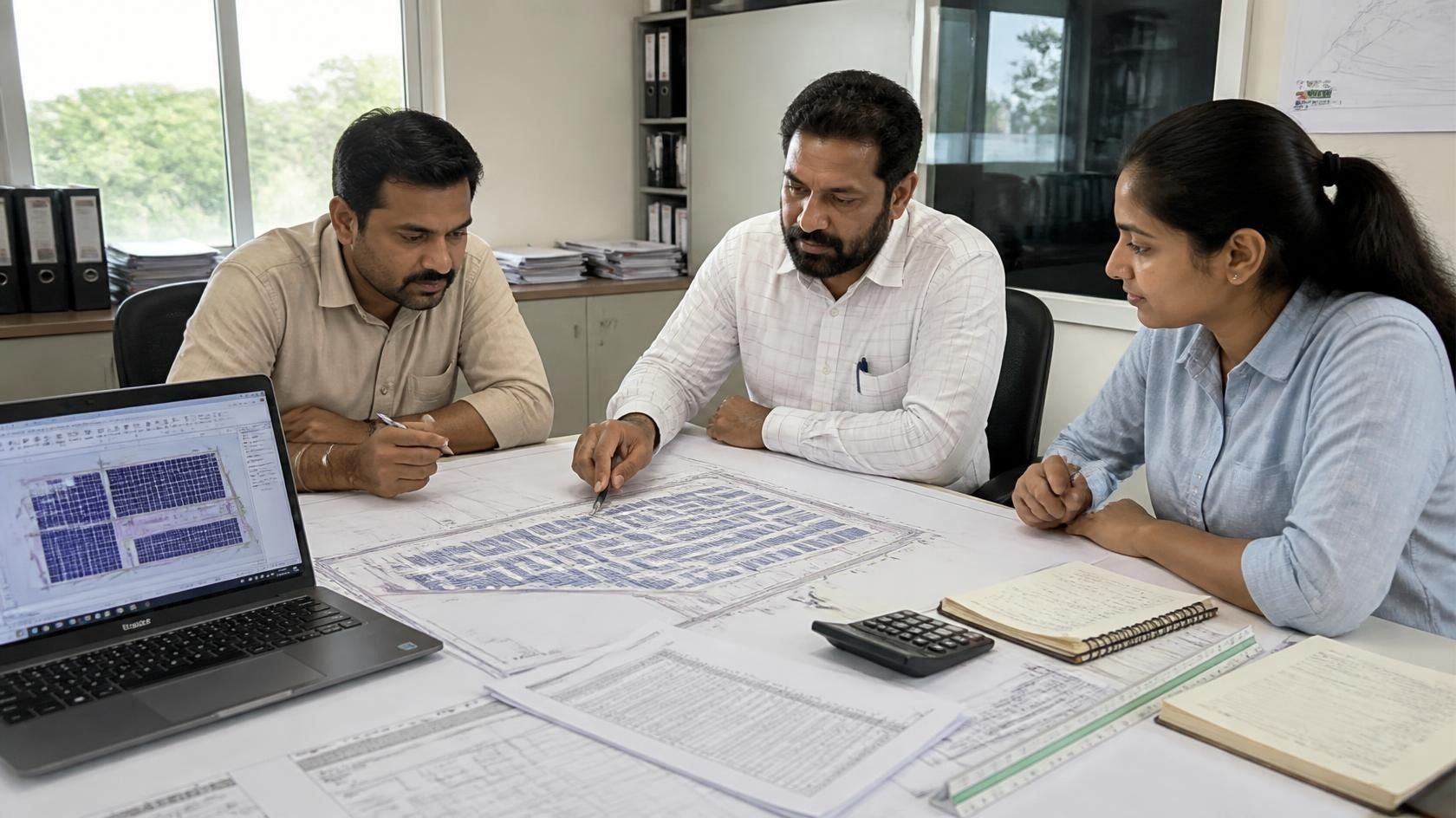
India’s solar EPC market is growing quickly.
More projects are coming.
Project sizes are increasing.
Competition is becoming stronger.
Clients are becoming more demanding.
But there is one important difference that often gets ignored.
Winning a solar EPC project does not guarantee making money from it.
Two EPCs can take projects of similar size.
They can use similar modules.
t=”603″ data-end=”606″ />>Similar inverters.
=”yoast-text-mark” data-start=”624″ data-end=”627″ />>Similar structures.
>Similar manpower.
Still, one project can remain profitable while the other slowly loses its margin.
So what creates the difference?
It is not always the selling price.
It is what happens before and during execution.
Profitability Starts Before Installation
Many EPCs start thinking about profit after winning the project.
By that time, several important decisions may already be locked.
The project has already been quoted.
The major materials may already be selected.
The client timeline may already be committed.
Now there is very little room for mistakes.
Successful EPCs think differently.
They ask important questions before execution:
- Is the site properly understood?
- Is the layout practical?
- Is the structure optimized?
- Is the electrical routing clear?
- Does the BOQ match the actual requirement?
- Are there hidden site risks?
- Can the project be executed as planned?
These questions may not look like profit-making activities.
But they protect the profit later.
The Difference Starts With Better Planning
A solar project can look simple from a distance.
Panels.
Structures.
Inverters.
Cables.
But every project has its own conditions.
A rooftop may have:
- Water tanks
- AC outdoor units
- Parapet walls
- Existing structures
- Different roof levels
- Shading obstacles
A ground-mount project may have:
- Uneven terrain
- Land boundaries
- Drainage requirements
- Access roads
- Different soil conditions
- Transmission constraints
If these factors are not considered early, the project can become expensive during execution.
Better planning reduces uncertainty before uncertainty becomes cost.
Rework Is One of the Biggest Profit Killers
Rework is often treated as a small execution problem.
It is not.
Imagine a structure position needs to be changed after installation has already started.
The EPC may need:
- Additional labour
- Additional material
- More transportation
- More site supervision
- More time
The original work may need to be removed and completed again.
The client may also ask:
“Why was this not identified earlier?”
One mistake may not destroy a project.
But repeated mistakes can slowly consume the entire margin.
That is why profitable EPCs try to prevent rework rather than manage it later.
BOQ Accuracy Protects the Project Margin
The BOQ is more than a procurement document.
It is connected directly to project profitability.
If quantities are underestimated, the EPC may have to purchase additional material later.
If quantities are overestimated, unnecessary inventory can affect cash flow.
Common problem areas include:
- Mounting structures
- DC cables
- AC cables
- Cable trays
- Earthing materials
- Protection equipment
- Fasteners
- Civil materials
A properly coordinated design and BOQ help procurement teams purchase what the project actually needs.
A small quantity error multiplied across a large project can become a significant financial difference.
Layout Decisions Can Affect Project Cost
Solar layout is not simply about fitting the maximum number of panels.
It is about finding the right balance between:
- Generation
- Land utilization
- Shading
- Structure quantity
- Cable length
- Access
- Maintenance
- Safety
For example, a layout that uses slightly more panels but creates complicated cable routes may not be the most economical solution.
Similarly, a layout that saves cable length but creates difficult maintenance access may create problems later.
The best layout is not necessarily the one that looks best on paper.
It is the one that works efficiently from design through execution and operation.
Electrical Planning Can Protect Long-Term Returns
Electrical decisions can affect both project cost and system performance.
Important considerations include:
- String configuration
- Inverter loading
- DC cable sizing
- AC cable sizing
- Voltage drop
- Protection devices
- Earthing
- Cable routing
Poor planning can result in unnecessary cable length or inefficient routing.
It can also create installation difficulties and future maintenance problems.
A well-coordinated electrical design helps the EPC understand the system before installation begins.
That clarity reduces site-level decisions.
And fewer unexpected decisions mean better cost control.
Structural Planning Is Not Just About Strength
For solar projects, the structure has two important roles.
It must be structurally appropriate.
And it must also be practical to manufacture and install.
An unnecessarily complicated structure can increase:
- Steel consumption
- Fabrication time
- Transportation
- Installation labour
On the other hand, under-designed or poorly coordinated structures can create serious execution problems.
The objective is not simply to use more steel.
The objective is to achieve the right structural solution for the project conditions.
Engineering efficiency and cost efficiency should work together.
Site Execution Reveals the Quality of Preparation
A well-prepared project usually feels different on site.
The site team knows:
- Where modules should go
- Where structures should be installed
- Where cables should run
- Where equipment should be positioned
- What materials are required
There are fewer questions.
Fewer interruptions.
Fewer last-minute decisions.
Compare that with a project where drawings keep changing.
The site team waits for clarification.
Procurement waits for updated quantities.
Installation stops.
Management starts coordinating multiple problems at the same time.
The project may still finish.
But the margin has already started disappearing.
Speed Is Not Always the Same as Efficiency
EPCs are under constant pressure to complete projects quickly.
But there is a difference between working fast and working efficiently.
Fast execution with poor preparation can create:
- Rework
- Material wastage
- Labour inefficiency
- Quality issues
- Project delays
Efficient execution is different.
It means the team already knows what needs to happen.
That is why strong preparation can actually make installation faster.
The best way to improve site speed is often to reduce the number of decisions the site has to make.
Procurement and Engineering Must Work Together
One common problem in EPC projects is a gap between engineering and procurement.
Engineering prepares one requirement.
Procurement purchases something slightly different.
The site team then discovers the difference during installation.
Now everyone has a problem.
Better EPC workflows connect:
Engineering → BOQ → Procurement → Site Execution
When these four stages are aligned, material movement becomes more predictable.
The site gets what it needs.
Procurement has better visibility.
Engineering knows what is being purchased.
And management has better cost control.
Client Communication Also Protects Profit
Profitability is not only about material and labour.
Client communication matters too.
Unclear communication can lead to:
- Scope changes
- Additional revisions
- Delayed approvals
- Misunderstandings
- Unplanned work
Successful EPCs communicate important decisions early.
They document changes.
a-end=”7990″>They clarify responsibilities.
“7992” data-end=”8053″>They avoid assuming that everyone understands the same thing.
Good communication reduces commercial surprises.
Ground-Mount Projects Multiply Small Mistakes
Ground-mount solar projects make planning even more important.
A small error can repeat across hundreds or thousands of modules.
For example:
A minor row-spacing issue may affect the entire block.
A cable-routing decision may be repeated across the site.
A structural issue may affect hundreds of foundations.
That is why ground-mount projects need coordinated planning before construction.
The larger the project becomes, the more expensive small mistakes can become.
Profitability Is Also About Risk Control
Every EPC project has risks.
Some are visible.
Others are hidden.
Examples include:
- Site conditions
- Material availability
- Design changes
- Client approvals
- Grid requirements
- Labour availability
- Weather
- Transportation
A profitable EPC does not assume everything will go perfectly.
It identifies potential problems early.
Then it decides:
What can we control before execution begins?
That mindset creates stronger projects.
Why Some EPCs Can Scale Better
When an EPC has only one project, the team can sometimes solve problems through personal coordination.
But as project volume increases, that becomes difficult.
Multiple sites require:
- Standard workflows
- Document control
- Drawing coordination
- Revision management
- Procurement coordination
- Clear responsibilities
Without these systems, growth creates chaos.
With them, growth becomes manageable.
That is why some EPCs can handle multiple projects while others become overloaded even with fewer projects.
The Real Difference Is Not Always Visible
Two EPC projects may look almost identical from outside.
Same panels.
Same inverter capacity.
Similar structures.
Similar site conditions.
But behind the scenes, one team may have:
- Better planning
- Better documentation
- Better coordination
- Better BOQ control
- Better engineering reviews
- Better execution preparation
That difference may not be visible in the first week.
But it becomes visible in the final project cost.
The Real Formula Behind Profitability
So why do some solar EPC projects stay profitable while others lose money?
The answer is not one single factor.
It is the combination of many small decisions.
Better planning.
Accurate quantities.
Coordinated engineering.
Controlled procurement.
Clear execution drawings.
Reduced rework.
Better communication.
Disciplined site management.
When these elements work together, the project becomes more predictable.
And predictable projects are easier to control financially.
Final Thoughts
India’s solar EPC market will continue to become more competitive.
Winning projects will remain important.
But winning the project is only the beginning.
The real challenge is delivering the project without allowing unnecessary costs to consume the margin.
The EPCs that understand this difference will have an advantage.
They will not simply focus on:
“How quickly can we install?”
They will ask:
“How well can we prepare before we install?”
Because in solar EPC:
Revenue comes from winning projects.
Profit comes from controlling them.
And strong engineering, accurate planning, and disciplined execution are what help turn a solar project from a contract into a profitable project.
